
General Tips
The Fabric Calculator rounds to the nearest whole unit (inch or millimeter).
Where seams are required, use an overlapping or semi-flat felled seam. A 1-inch seam allowance will automatically be added to the fabric total.
Refer to the Cut Panel Rendering for an example of how to pattern your fabric. Double check that the fabric is being used efficiently.
- Box Cushion Tips ›
- Folded Over Foam Tips ›
- Platform Cushion Tips ›
- Irregular Cushion Tips ›
- Throw Pillows Tips›
- Bolster Pillow Tips ›
- Standard Awning Tips ›
- Rectangular Awnings Tips ›
- Sail Shade Tips ›
- Tarp Tips ›
- Umbrella Tips ›
- Window Curtain Tips ›
- Window Shade Tips ›
- Window Shade Tips ›
- Roman Shade Tips ›
Box Cushion Tips
The Fabric Calculator rounds to the nearest whole unit (inch or millimeter).
Where seams are required, use an overlapping or semi-flat felled seam. A 1-inch seam allowance will automatically be added to the fabric total.
Refer to the Cut Panel Rendering for an example of how to pattern your fabric. Double check that the fabric is being used efficiently.
If using precut foam, use the foam's measurements for the calculator. If not, measure the space the cushion will fill. When cutting the foam, add a 1/2-inch to all sides.
Be sure to include the perimeter of cutouts or notches in the width or height of irregular cushions.
For cushions with convex edges or curves, order extra fabric to allow for these irregularities.
Folded Over Foam Cushion Tips
The Fabric Calculator rounds to the nearest whole unit (inch or millimeter).
Where seams are required, use an overlapping or semi-flat felled seam. A 1-inch seam allowance will automatically be added to the fabric total.
Refer to the Cut Panel Rendering for an example of how to pattern your fabric. Double check that the fabric is being used efficiently.
If using precut foam, use the foam's measurements for the calculator. If not, measure the space the cushion will fill. When cutting the foam, add a 1/2-inch to all sides.
Be sure to include the perimeter of cutouts or notches in the width or height of irregular cushions.
For cushions with convex edges or curves, order extra fabric to allow for these irregularities.
For plywood backing, a heavy-duty (T-50) stapler can be used to staple the fabric. For Starboard backing, a professional stapler like the Duo-Fast EIC 3118 will give a neater and more secure hold.
Platform Cushion Tips
The Fabric Calculator rounds to the nearest whole unit (inch or millimeter).
Where seams are required, use an overlapping or semi-flat felled seam. A 1-inch seam allowance will automatically be added to the fabric total.
Refer to the Cut Panel Rendering for an example of how to pattern your fabric. Double check that the fabric is being used efficiently.
If using precut foam, use the foam's measurements for the calculator. If not, measure the space the cushion will fill. When cutting the foam, add a 1/2-inch to all sides.
Be sure to include the perimeter of cutouts or notches in the width or height of irregular cushions.
For cushions with convex edges or curves, order extra fabric to allow for these irregularities.
For plywood backing, a heavy-duty (T-50) stapler can be used to staple the fabric. For Starboard backing, a professional stapler like the Duo-Fast EIC 3118 will give a neater and more secure hold.
Irregular Cushion Tips
The Fabric Calculator rounds to the nearest whole unit (inch or millimeter).
Where seams are required, use an overlapping or semi-flat felled seam. A 1-inch seam allowance will automatically be added to the fabric total.
Refer to the Cut Panel Rendering for an example of how to pattern your fabric. Double check that the fabric is being used efficiently.
If using precut foam, use the foam's measurements for the calculator. If not, measure the space the cushion will fill. When cutting the foam, add a 1/2-inch to all sides.
Be sure to include the perimeter of cutouts or notches in the width or height of irregular cushions.
For cushions with convex edges or curves, order extra fabric to allow for these irregularities.
Irregular cushions often have one "wedged" edge to fit against the slat of a boat's hull. If so, enter the length and/or width measurements for the larger of the two plates. The smaller one can be trimmed to fit as needed.
Throw Pillow Tips
The Fabric Calculator rounds to the nearest whole unit (inch or millimeter).
Refer to the Cut Panel Rendering for an example of how to pattern your fabric. Double check that the fabric is being used efficiently.
Bolster Pillow Tips
The Fabric Calculator rounds to the nearest whole unit (inch or millimeter).
Refer to the Cut Panel Rendering for an example of how to pattern your fabric. Double check that the fabric is being used efficiently.
Use the pillow form to find the diameter and length measurements.
The Fabric Calculator does not add a seam allowance to the diameter or length of the pillow. You do not need to add fabric for this allowance. The measurements from a prefabricated pillow with 1/2-inch seams will result in a snug cover.
The Fabric Calculator adds 2-1/4 inch to the circumference of the barrel to accommodate a closure. This assumes a 1-inch fold on either side of the barrel for a Velcro closure. Other closure methods may require adding or subtracting from the barrel circumference.
Railroaded fabrics, patterns that run across the bolt instead of lengthwise with the warp, will reverse the meaning of Horizontal or Vertical for Pattern Direction.
Standard Awning Tips
The Fabric Calculator rounds to the nearest whole unit (inch or millimeter).
Where seams are required, use an overlapping or semi-flat felled seam. A 1-inch seam allowance will automatically be added to the fabric total.
Refer to the Cut Panel Rendering for an example of how to pattern your fabric. Double check that the fabric is being used efficiently.
When side curtains are desired, the Fabric Calculator will add the fabric needed for 2 side curtains with valance to the total estimate. The diagram pictures an awning with side curtains.
Create a scalloped edge along the bottom of the valance if desired. Cut a cardboard template to use as a pattern for marking and cutting your fabric.
The head rod, typically a metal rod that slides into a sleeve or hem, supports the very top of the awning near where the awning is attached to a structure.
Projection refers to the slope of the awning from the head rod to the front bar (not including the valance).
A grommet strip, strip of fabric with grommets installed along the length, is sewn to the underside of the awning (above the valance and awning tie bar) and used with lacing line to secure the awning to the awning tie bar.
Rectangular Awning Tips
The Fabric Calculator rounds to the nearest whole unit (inch or millimeter).
Where seams are required, use an overlapping or semi-flat felled seam. A 1-inch seam allowance will automatically be added to the fabric total.
Refer to the Cut Panel Rendering for an example of how to pattern your fabric. Double check that the fabric is being used efficiently.
A double hem is an edge that is folded over twice, resulting in 3 layers of material (ideal thickness for fastener installation).
Sail Shade Tips
The Fabric Calculator rounds to the nearest whole unit (inch or millimeter).
Where seams are required, use an overlapping or semi-flat felled seam. A 1-inch seam allowance will automatically be added to the fabric total. A 4-sided miter cut sail shade also requires a diagonal seam.
Refer to the Cut Panel Rendering for an example of how to pattern your fabric. The blue area represents the hem material. Rotate the roll of fabric at the end of each cut to minimize waste. Note that the parallel four sided calculator does not assume rotation -- if rotation is employed there will be some extra fabric left over. We did not rotate here in order to make the graphic representation more intuitive. Let us know whether you prefer assumed rotation. Double check that the fabric is being used efficiently.
Sail Awnings are often attached only at the corners. To prevent drooping or flapping fabric on the edges, create a hollow from 5-10% of the side length at the center of the side before hemming. If the hollow is lofted on the floor and panels are cut accurately prior to assembly (rather than laying them out over straight edges and trimming after assembly), there will be a 15 to 40 percent saving in yardage over the figure returned by the calculator depending on the extent of the hollow.
A double hem is an edge that is folded over twice, resulting in 3 layers of material (ideal thickness for fastener installation).
Tarp Tips
The Fabric Calculator rounds to the nearest whole unit (inch or millimeter).
Where seams are required, use an overlapping or semi-flat felled seam. A 1-inch seam allowance will automatically be added to the fabric total.
Refer to the Cut Panel Rendering for an example of how to pattern your fabric. Double check that the fabric is being used efficiently.
A double hem is an edge that is folded over twice, resulting in 3 layers of material (ideal thickness for fastener installation).
Umbrella Tips
Umbrellas are made up of a number of pie shaped “gores” radiating out from a center point. The seams of each gore normally lie over a rib. An umbrella with 8 gores will have 8 ribs. If the ribs are straight when extended, the gores will have straight sides – each gore will make up a flat slanted section. This shape is represented in the illustration below.
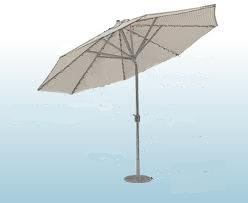
If the ribs are flexible and give the umbrella a domed shape when open, the gores will have curved sides that determine the shape of the curve. Very little need be added to the sides of each gore to create a normal umbrella dome shape: a curve just 3% of the center gore width deep on each gore side will provide for a nice dome similar to that shown below.
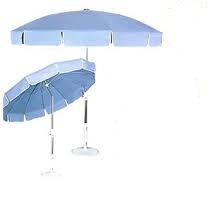
Notice that the gores are cut straight from rib end to rib end. If there is a fringe or a curtain, it will usually be segmented along the straight outside edge of each gore (see the Domed Umbrella illustration). Otherwise ugly wrinkles will be likely at the end of each rib.
There is almost always a 16 inch or so opening in the center of the umbrella. This helps prevent a strong wind from carrying the awning away by reducing any buildup of air pressure underneath. A 28 inch circle of fabric (a “vent fly”) is tack sewn over this opening at each rib location along its outer circumference.
Umbrellas are cone shaped to encourage water runoff and to provide cozy shade. The extent of the cone is determined by making the combined circumference of the gores less than the circumference that would be created by multiplying cone radius by 2 Pi. If making a replacement umbrella, the cone can be duplicated by measuring the open umbrella diameter from one rib tip to another directly opposite in a straight line. If this diameter measurement is not possible, it can normally be assumed to be about 10% less than the total of a gore radius multiplied by 2. For those with a mathematical bent, the Pythagorean Theorem can be used to find the proper umbrella open diameter – the radius of the open umbrella equals the square root of the remainder of the rib radius squared minus the desired cone height squared. Double this result to obtain the desired open diameter.
Umbrellas normally have just a 1 inch or so double folded hem along each gore running from rib to rib on the outer edge of the circle. A small pocket is often sewn to the underside of the fabric into which each rib can be inserted. Fringe or curtain fabric can be attached to the outside edge of each gore after the hem and pockets are fashioned. The inner points of the gores can be folded back to create a small opening for the finial at the center of the frame. If desired, a fly cover in the shape of a small circle can be sewn loosely at intervals over this opening to prevent leakage.
We like to use the “semi-flat felled” seam to join all the gores together. The measurements produced by the Fabric Calculator include ½ inch (12.5 mm) of extra cloth on the two radiating edges of each gore panel (notice that each gore has a truncated tip just 1 inch - 25mm – wide and that the base of each gore is 1 inch wider than the circumference of the finished umbrella divided by the number of gores – this extra fabric will be used to create seams). To make the seams, lay two gores on top of one another top-surface to top-surface and place a single row of straight stitches ½ inch (12.5 mm). inside the edge. Then unfold the assembly. Press the seam allowance one way or the other and run a second row of stitches over it all along the length of the gore.
Window Curtain Tips
The Fabric Calculator rounds to the nearest whole unit (inch or millimeter).
Where seams are required, use an overlapping or semi-flat felled seam. A 1-inch seam allowance will automatically be added to the fabric total.
Refer to the Cut Panel Rendering for an example of how to pattern your fabric. Double check that the fabric is being used efficiently.
The Vertical Repeat of your fabric may result in a gap (or fabric excess) on the Cut Panel Rendering so that the fabric pattern will match both between and within the two panels.
Hems (we assume 1/2 inch hems on each side of the curtain halves or 2 inches total) are added to the width prior to factoring the multiplier.
The Fabric Calculator generates an estimate (with width rounded up for each panel) for a pair of curtain panels (as shown in diagram).
Window Shade Tips
The Fabric Calculator rounds to the nearest whole unit (inch or millimeter).
Where seams are required, use an overlapping or semi-flat felled seam. A 1-inch seam allowance will automatically be added to the fabric total.
A 1-inch hem is added to each side of the window shade.
Roman Shade Tips
The Fabric Calculator rounds to the nearest whole unit (inch or millimeter).
Where seams are required, use an overlapping or semi-flat felled seam. A 1-inch seam allowance will automatically be added to the fabric total when necessary.
A 1-inch hem is added to each side of the window shade.
The depth of a finished roman shade when it is fully retracted will be roughly 9 inches plus 1-1/4 inch for each fold in the curtain (the number of folds will equal the number of battens plus 1 for the rod pocket).